How Bailipower Helps Customers Choose and Use Busbar Machines Scientifically — Understanding Why Displacement Accuracy Matters More Than Angle Accuracy in CNC Busbar Bending
In the field of three-station CNC busbar machine bending, a long-standing misunderstanding has influenced how many customers evaluate equipment: the belief that bending angle accuracy is the most important indicator of machine precision. While angle accuracy is easy to observe, it is not the real parameter that determines bending quality. From a geometric and calculus-based perspective, busbar bending is essentially a process of precise displacement control, and the bending angle is only the visible result of that displacement.
At Bailipower, we help customers make better purchasing decisions and achieve better machining results by explaining the scientific principles behind busbar bending. Instead of promoting simplified marketing indicators, we focus on the true core factor — die displacement accuracy — and guide customers to choose the right three-station CNC busbar machine based on real engineering logic.
The Industry Misunderstanding: Using Angle Accuracy as the Only Standard
In many busbar processing factories, machine precision is often judged by how accurate the final bending angle appears. Customers frequently ask questions such as:
How many degrees of error does the machine have?
Can the machine keep 90° exactly?
What is the angle tolerance?
These questions seem reasonable, but they overlook the actual control mechanism of a CNC busbar bending system.
During bending, the CNC system does not directly control the angle.
Instead, it calculates a limit displacement value based on parameters such as:
Die width
Material thickness
Bending angle setting
Mechanical structure geometry
The machine then moves the bending die to that calculated position.
The final angle is only the geometric result of the displacement.
This means that angle accuracy is not the control variable — displacement is.
Bailipower explains this clearly to customers before machine selection, helping them avoid choosing equipment based on misleading specifications.
Why Displacement Accuracy Determines Bending Accuracy
When a three-station CNC busbar machine performs a bending operation, the control system calculates the theoretical travel distance of the bending die. The machine executes this movement precisely according to the calculated value, without measuring the angle directly during the motion.
Because of this, even a very small displacement error can cause different angle errors depending on the bending condition.
For example, when using a 30 mm bending die:
A displacement error of 0.1 mm may cause about 0.4° deviation at 90° bending
The same displacement error may cause about 0.6° deviation at 120° bending
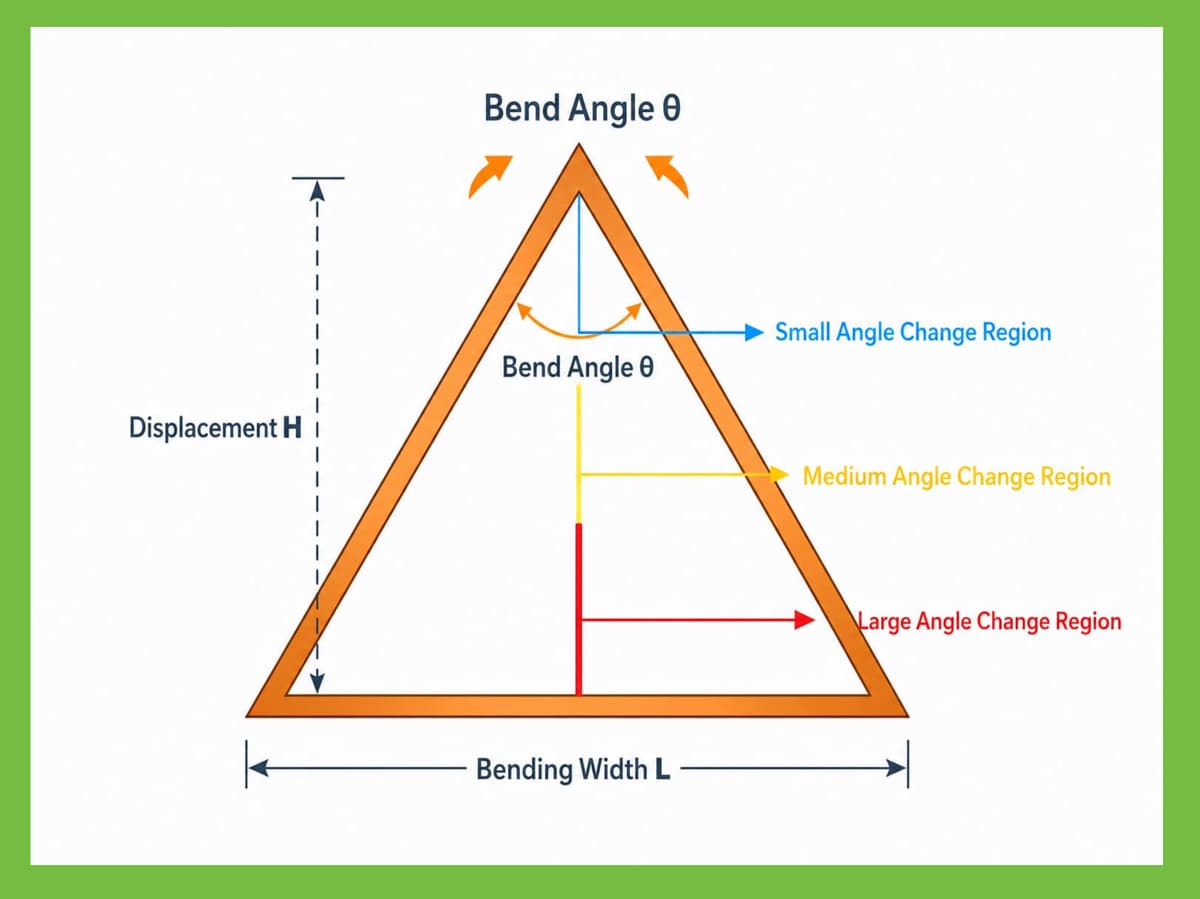
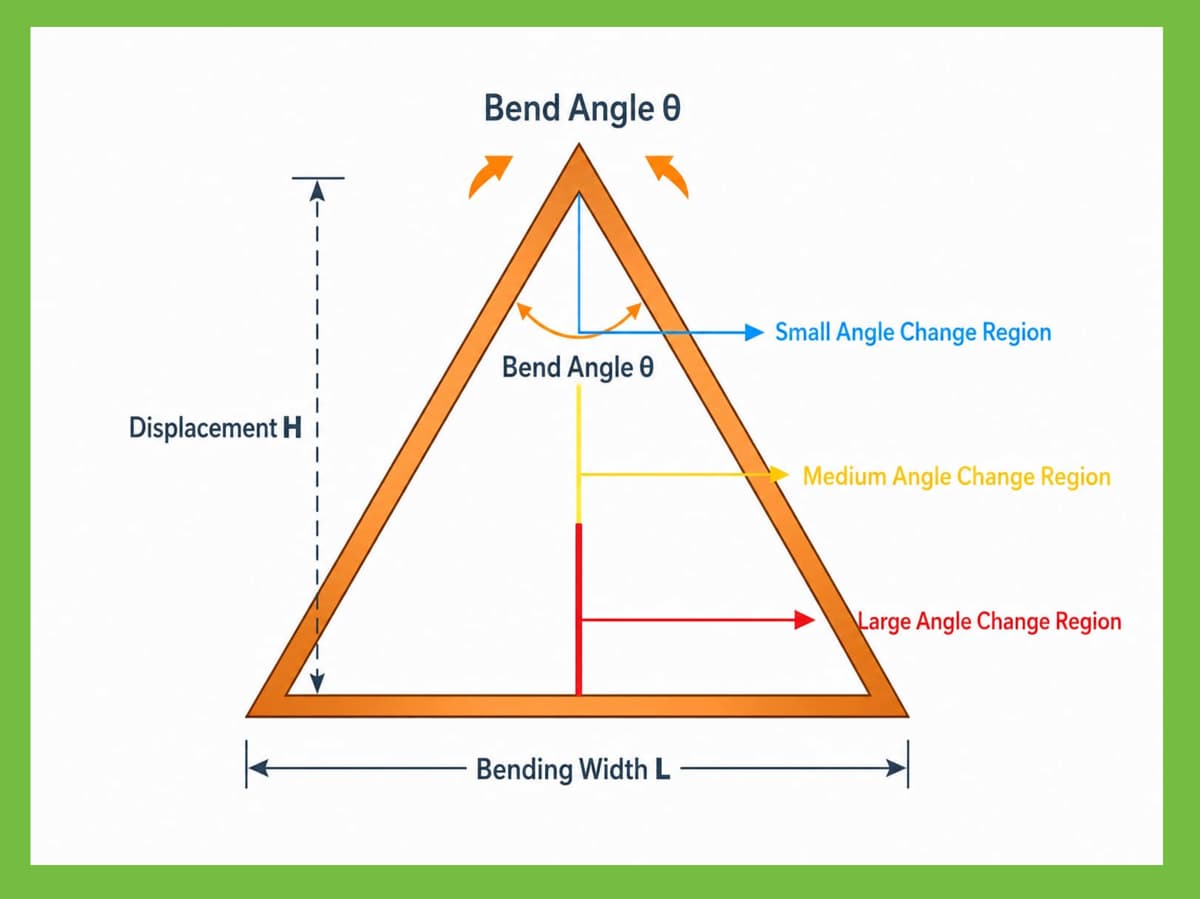
This phenomenon can be explained by geometric deformation principles.
In a triangle-like deformation process, when the same linear change occurs, the angle change near the base is larger than the angle change near the top. As the bending angle increases, the sensitivity to displacement error also increases.
Therefore:
Angle error is a variable result, but displacement error is the real source.
This is why Bailipower always teaches customers to evaluate machines based on servo control precision, mechanical rigidity, and displacement stability, not just angle display.
How Bailipower Designs Three-Station CNC Busbar Machines Based on Scientific Principles
At Bailipower, product development is based on engineering logic rather than marketing concepts.
When designing three-station CNC busbar machines, we define displacement accuracy as the core technical standard.
To achieve high stability, our machines use:
High-precision servo control systems
High-rigidity bending structures
Precision ball screw or hydraulic positioning systems
Optimized die design with minimal deformation
Stable limit positioning mechanisms
These features ensure that the bending die always reaches the correct position, reducing the root cause of angle deviation.
Because displacement error is minimized, the machine can maintain stable bending accuracy under different angles, different die widths, and different material sizes.
This approach allows customers to achieve consistent results in real production, not just in test demonstrations.
Helping Customers Choose the Right Busbar Machine
Many customers select busbar machines based only on price or angle tolerance claims, which often leads to problems during real production. Bailipower believes that helping customers choose correctly is as important as manufacturing the machine itself.
Before recommending a machine, we analyze:
Busbar size range
Required bending angles
Production volume
Material type
Accuracy requirements
Operator experience level
Then we explain the relationship between:
Die width
Displacement calculation
Angle variation
Machine rigidity
Control precision
This process allows customers to understand why some machines appear accurate in simple tests but become unstable in real work.
By understanding the principle of displacement control, customers can select equipment that truly matches their production needs.
This is one of the key reasons why many factories choose Bailipower for long-term cooperation.